The correlogram constructs an estimate of the power spectrum using a windowed fast Fourier transforms (FFT) of the autocorrelation function of the time series. It was developed by Blackman and Tukey (1958) and is based on the Wiener-Khinchin theorem, which states that if the Fourier transform of a series x(t) is X(f), and if the autocorrelation function of the series is R, then the Fourier transform of R yields PX(f)=|X(f)|2 or the power spectrum of x(t). The resulting power-spectrum estimate is called a correlogram. An alternative that is not included in the Toolkit is direct or windowed FFT of the time series itself, called a periodogram.
Both periodograms and correlograms are usually performed on weighted versions of the time series or autocorrelation functions in order to reduce power leakage (artificially high power estimates at frequencies away from the true peak frequencies). Press et al. (1989, pp. 423-424) note that "when we select a run of N sampled points for periodogram spectral estimation, we are in effect multiplying an infinite run of ... data ... by a window function in time, one which is zero except during the total sampling time [NDt], and is unity during that time." The sharp edges of this window function contain much power at highest frequencies, which is imparted to the windowed signal and leads to power leakage. A similar argument can be made for correlograms. Weighting the data or correlation function by various tapered shapes (high in center and falling off to sides) is an accepted traditional approach to reducing power leakage.
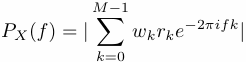
In the Blackman-Tukey approach PX(f) is estimated by
Read More
Both periodograms and correlograms are usually performed on weighted versions of the time series or autocorrelation functions in order to reduce power leakage (artificially high power estimates at frequencies away from the true peak frequencies). Press et al. (1989, pp. 423-424) note that "when we select a run of N sampled points for periodogram spectral estimation, we are in effect multiplying an infinite run of ... data ... by a window function in time, one which is zero except during the total sampling time [NDt], and is unity during that time." The sharp edges of this window function contain much power at highest frequencies, which is imparted to the windowed signal and leads to power leakage. A similar argument can be made for correlograms. Weighting the data or correlation function by various tapered shapes (high in center and falling off to sides) is an accepted traditional approach to reducing power leakage.
In the Blackman-Tukey approach PX(f) is estimated by
Read More

No comments:
Post a Comment