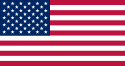
 The United States of America (commonly called the United States, the U.S., the USA, America, and the States) is a federal constitutional republic comprising fifty states and afederal district. The country is situated mostly in central North America, where its forty-eight contiguous states and Washington, D.C., the capital district, lie between the Pacific andAtlantic Oceans, bordered by Canada to the north and Mexico to the south. The state of Alaska is in the northwest of the continent, with Canada to the east and Russia to the west across the Bering Strait. The state of Hawaii is an archipelago in the mid-Pacific. The country also possesses several territories in the Pacific and Caribbean.
At 3.79 million square miles (9.83 million km2) and with over 314 million people, the United States is the third- or fourth-largest country by total area, and the third-largest by both land area and population. It is one of the world's most ethnically diverse and multicultural nations, the product of large-scale immigration from many countries.[6] The U.S. economy is the world's largest national economy, with an estimated 2011 GDP of $15.1 trillion (22% of nominal global GDP and over 19% of global GDP at purchasing-power parity).[3][7] Per capita income is the world's sixth-highest.[3]
In what is now the co-terminous United States, indigenous peoples descended from Paleo-Indians migrated from Asia and completely displaced earlier populations of Mound Builders by 1500. This Native American population was in turn greatly reduced primarily by disease after European contact. By 1610, European empires had established a permanent presence in French Quebec, Spanish Santa Fe and English Jamestown. The United States itself was initially derived from thirteen British colonies located along the Atlantic seaboard. On July 4, 1776, delegates to the Continental Congress issued the Declaration of Independence, which proclaimed their right to self-determination, autonomy from Great Britain, and their establishment of a "perpetual", sovereign union. The rebellious states defeated the British Empire in the American Revolution, the first successful colonial war of independence.[8] The current United States Constitution was adopted on September 17, 1787; its ratification the following year made the states part of a single republic with a stronger central government. TheBill of Rights, comprising ten constitutional amendments guaranteeing many fundamental civil rights and freedoms, was ratified in 1791.
Through the 19th century, the United States expanded its borders, building on the gains of the Treaty of Paris (1783). It displaced native tribes, enemies, allies and treaty residents alike, acquired the Louisiana territory from France, and Florida from Spain. It secured boundaries with U.K. colonies in the War of 1812 including Maine. Mid-century it annexed the Republic of Texas, partitioned the Oregon Country, gained the Mexican Cession and purchased Alaska from Russia. The Plains Indian Wars relocated remaining Amerindian tribes onto confined reservations, Congressional Resolution annexed the Republic of Hawaii, then the treaty ending the Spanish-American War ceded Puerto Rico and Guam. During the early territorial expansion, significant disputes between the agrarian slave-holding South and free-soil industrial North led to the American Civil War. The North's victory reestablished the Union, and led to the ratification of the Thirteenth Amendment to the United States Constitution, ending legalized slavery in the United States. By the end of the nineteenth century, its national economy was the world's largest, with steel production greater than Great Britain, France and Germany combined.[9]
The Spanish–American War and World War I confirmed the country's status as a global military power. It emerged from World War II as the first country with nuclear weapons and apermanent member of the United Nations Security Council. The end of the Cold War and the dissolution of the Soviet Union left the United States as the sole superpower. The country accounts for 41% of global military spending,[10] and is a leading economic, political, and cultural force in the world.[11]

No comments:
Post a Comment